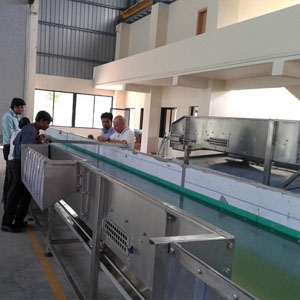
This is a type of mechanical handling equipment that moves things from one place to another which is known as the Conveyor System. Conveyors are very helpful in situations where large or bulky products must be transported. Conveyors have been widely used in the material handling and packaging sectors because they allow for speedy and effective delivery of a wide range of products. They\’re also popular with customers, as they\’re frequently found at supermarkets and airports, where they serve as the final leg of item/bag
delivery to customers. Conveying systems come in a variety of shapes and sizes, and they\’re employed to meet the demands of numerous sectors. There are also chain conveyors (both floor and above). Enclosed tracks, I-Beam, towline, power & free, and hand-pushed trolleys are all examples of chain conveyors.
Industries where it is used
Because of the multiple benefits that conveyor systems provide, they are widely employed across a variety of sectors. Conveyors can securely carry items from one place to another, which is hard to do and costly if done by humans. They can transfer loads of different shapes, sizes, and weights and can be mounted practically anywhere. Making them far safer than using a forklift or other machine to transport items. Many also have improved safety counts that aid in the prevention of accidents.
Conveying systems may be run in a variety of ways. What are hydraulic, mechanical, and completely automated systems, all of which can be customized to meet specific requirements? Mining, automotive, agricultural, computer, electrical, food processing, aerospace, pharmaceutical, chemical, bottling and canning, print finishing, and packaging are just a few of the sectors that employ conveyor systems. Food products such as beans and nuts, bottles and cans, automotive components, scrap metal, medications and powders, wood and furniture, and grains & animal products just are a few of the goods that can be
carried. When it comes to picking the right conveyor system, there are a lot of things to consider. It\’s critical to understand how the conveyor system will be used ahead of time. The required conveyor activities, such as transport, accumulation, and sorting, the material sizes, weights, and shapes, and where the loading and pickup locations are needed are all factors to consider.
How to maintain conveyor systems
A conveyor system is frequently the lifeblood of a firm\’s ability to transfer goods safely and on time. There should be regular inspections and system audits, constant monitoring of motors and reducers. The other needed factor keeping important components in stock. The firm should give a thorough education to the staff and all seem to be in action. which a firm must take to ensure that it runs at peak capacity. Selecting the correct conveyor type, system design, and regular checkup plans. Which are the major elements in prolonging the life of a conveyor system. By efficient process, a smartly built conveyor system will endure for a long time. Overhead conveyor systems have been used in a variety of venues. We can also include retail displays, production lines, or paint finishing plants, among others.
Growth in different industries
Material handling and conveyor system vendors are gaining from higher exposure in industries such as automotive, pharmaceutical, packaging, and several manufacturing plants in terms of growth. In the construction sector, mobile conveyors are also gaining popularity, and by 2022, the rate of conveyor system purchases in North America, Europe, and Asia is bound to grow even more. At packaging manufacturing and industrial plants, line-shaft roller conveyors, chain conveyors, and conveyor belts are the most widely purchased types of conveyors. Conveyors are increasingly being used in the commercial and civil sectors, such as airports and shopping malls.
Types of Conveyors
| Aero-mechanical conveyor | Chain-driven live roller conveyor |
| Automotive conveyor | Drag conveyor |
| Belt conveyor | Dust-proof conveyor |
| Belt-driven live roller conveyor | Electric track vehicle system |
| Bucket conveyor | Flexible conveyor |
| Chain conveyor | Gravity conveyor |
| Gravity skate-wheel conveyor | Plastic belt conveyor |
| Lineshaft roller conveyor | Pneumatic conveyor |
| Motorised roller conveyor | Screw or auger conveyor |
| Overhead I-beam conveyor | Spiral conveyor |
| Overland conveyor | Tubular Gallery conveyor |
| Vacuum conveyor | Vibrating conveyor |
| Walking Beam | Wire mesh conveyor |
Pneumatic
 Every pneumatic system makes use of transport lines, which are pipes or ducts that carry a mixture of items as well as a stream of air. Cement and fly ash are examples of free-flowing powdered materials. Air pressure pushes products through tubes. Pneumatic conveyors are either carrier systems or dilute-phase systems; carrier systems simply push goods from one location to another, such as the money-exchanging pneumatic tubes at a bank drive-through window. Push-pull pressure is used in dilute-phase systems to guide materials through the various entrance and exit points. The airflow can be generated using air compressors or blowers. There are three systems that are utilized to create a high-velocity air stream:
Suction or vacuum systems, which pull the substance with the surrounding atmosphere by creating a vacuum in the pipeline. The system operates at low pressure, about 0.4–0.5 atm below atmospheric pressure, and is primarily used to transport light, free-flowing materials. Positive-pressure systems, in which material is pushed from one location to the next using positive pressure. The system is perfect for transporting materials from a single loading point to several unloading stations. It works at pressures of 6 atm and higher. Combination systems, in which a suction system transports material from several loading sites and a pressure system transports it to multiple unloading locations.
Vibrating
 A vibrating conveyor is a machine having a solid conveying surface that is trough-shaped on one side. It is most often used to move dry bulk solid food-grade applications. where it is hard to maintain sanitation, washing down at a low cost is difficult. Conveyors can be used in very hot, dusty, or caustic conditions. It is used to move newly cast metal pieces that can attain temperatures of up to 1,500 degrees. Vibrating conveyors can also execute duties including sorting, screening, classifying, and orienting pieces due to the stationary nature of the conveying pans.
Vibrating conveyors are uniquely designed which can carry goods at many angles than 45 degrees. At a 5° slope from the horizontal line, flat pans will transport most materials.
Flexible

The flexible conveyor is built around an aluminum as well as wear-resistant conveyor beam with low-friction sliding rails that guide a multi-flexing plastic chain. Conveyable products are transported either directly on the conveyor or on pallets/carriers. These conveyors can work around obstructions and maintain the flow of production lines. It is available in a variety of sizes with advanced settings. Food packaging, case packing, and pharmaceutical sectors, and also huge retail outlets like Wal-Mart and Kmart, use them.
Closing It Up
As we discussed above, a conveyor system, as previously stated, is a type of mechanical handling equipment that transports goods from one location to another. As a result, there is less product breakage and damage. So, hopefully, I\’ve covered all of the many varieties of conveyor systems and their functions. If you still have any queries or questions about \”conveyor kinds,\” you can post them in the comments section.
Please share with your friends about this post if you enjoyed it. You can follow us on our Facebook page and LinkedIn business profile
Why Dewan Project Tech
- Dewan Project tech ensures timely supply of goods and equipment and also factors of transit & Insurance
- We can customize as per client needs.
- Finding the correct vendor who fits the needs in all commercial and technical fields.
- We work in a professional nature to fulfill the supply at the right time with to the quality factor as per firm norms.
- We keep secrecy to maintain our business ethics while dealing with the clients.
- Ensure the manufacturing department gets the supply without delay.
- taking control of the cost and process execution in line with multiple vendors.
- evaluating, selecting, auditing the vendor as per requirements of the customer with various vendors of the same specifications and maintaining the quality standards.
- Essentials of four R’s. At the right place with the right quality at right time at the right price
- We would get the suppliers on board at a genuine price.